Realistic without exposing the business.
Participants face constraints without risking real customers, staff, budgets, or reputations.
Bridge-Maker Behaviour Simulation Lab
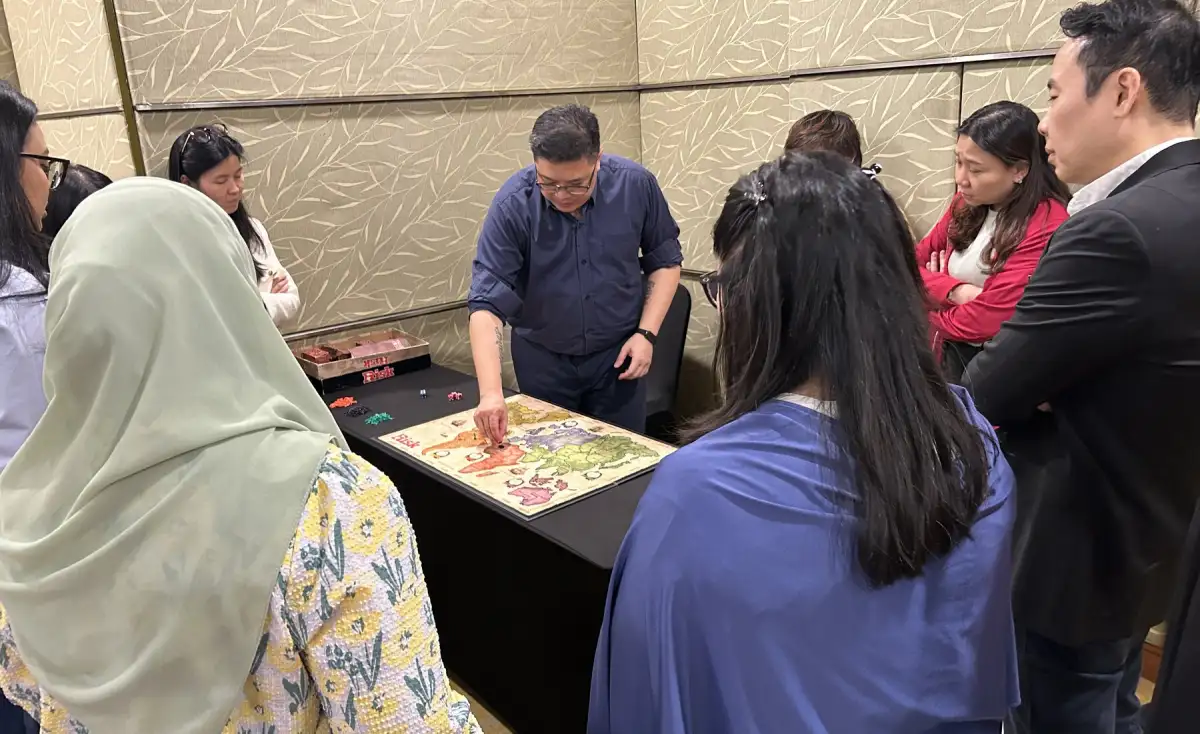
In a workshop, participants discuss a concept. In a simulation, they make decisions, see consequences, and notice their real behaviour before the debrief names it.
These are not games for entertainment. They are safe practice rooms with clear rules, guided pressure, and a structured debrief that turns visible behaviour into workplace action.
Evidence And Assurance
The simulation creates a record of what people do, then the debrief turns that evidence into one workplace action.
Participants face constraints without risking real customers, staff, budgets, or reputations.
Choices, delays, alliances, resource use, and consequences give the debrief something concrete to examine.
Each run closes with one named behaviour, one commitment, and one workplace action within 30 days.
A review of 145 studies found strong gains in complex skills, including management, when simulations include guidance and reflection.
Read the research recordSimulation Portfolio
Each simulation reveals one behaviour pattern. The game creates evidence, then the debrief turns that evidence into workplace action.
Values discovery experience that surfaces the hidden rules people build around what matters most.
Strategic decision-making under uncertainty, path choice, changing conditions, and speed of commitment.
Resource decisions, alliances, commitment, and leadership follow-through inside a mountain expedition scenario.
Sensitive conversation simulation that trains leaders to choose language that opens the conversation.
Wider Library
Cross-department transformation where local optimisation creates visible second-order effects.
Teams work from different priorities until the bridge event reveals the cost of limited coordination.
Hidden player profiles force coaches to use behavioural frameworks in real time.
Hidden resistance tests trust, persuasion, and genuine alignment.
Trade, alliance, performance, and honour tracked together.
Fifteen live negotiation rounds testing influence, tactics, and commitment under pressure.
Tests role fit, team composition, dependency, and resilience by design.
Hidden agendas, asymmetric win conditions, and organisational alignment.
How It Works
Participants decide, allocate, persuade, pause, commit, and adapt.
Scores, movements, resources, and consequences show what happened.
The facilitator connects the evidence to the workplace pattern.
One behaviour, one commitment, and one 30-day workplace action leave the room.
Plan A Simulation